
How to Size a Pneumatic Actuator for a Butterfly Valve: A Torque Calculation Walkthrough
Most actuator failures are sizing failures. A step-by-step torque calculation for butterfly valves — break torque, media and temperature factors, safety margin, air supply derating and spring-return checks — with a worked example.
How to Size a Pneumatic Actuator for a Butterfly Valve: A Torque Calculation Walkthrough
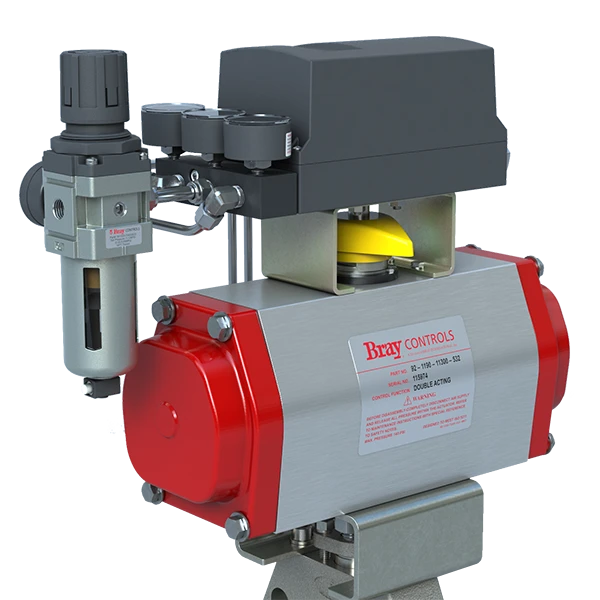
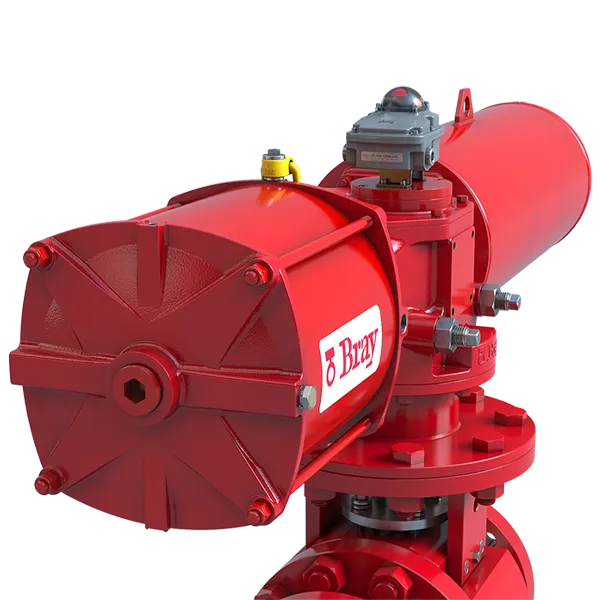
An actuator that is too small does not fail dramatically. It closes 95% of the way, the valve passes a little, the maintenance team increases the air pressure, and eighteen months later the seat is destroyed and everyone blames the valve. pneumatic actuators spring return pneumatic actuators
Sizing is not complicated, but it has to be done in the right order.
The four torques that matter
| Torque | What it is | When it applies |
|---|---|---|
| Break torque (breakaway) | Torque needed to start moving the disc out of the seat | At opening, worst case |
| Running torque | Torque needed to move the disc through mid-travel | During the stroke |
| Seating torque | Torque needed to press the disc or seal onto the seat | At closing, for tight shut-off |
| Residual torque | Torque left in the seat after seating | Between cycles |
For most resilient seated and double offset valves, break torque is the highest and drives the actuator selection. For torque-seated triple offset valves, seating torque can govern instead. Ask for both figures — a datasheet that only gives one number is not enough to size from.
Step 1 — Get the valve torque at your size and pressure class
Use the manufacturer's torque table for the specific series, size and pressure class at the design differential pressure. Do not use the torque at zero pressure: torque rises with differential pressure, and a valve sized at shut-off pressure will be undersized at full flow differential.
Step 2 — Apply the media factor
Clean water and dry gas are the baseline (factor 1.0). Increase for:
- Dry gas or dry air: 1.1–1.2 (drying and friction)
- Slurry or solids-bearing media: 1.2–1.4 (deposits and trapped particles)
- Crystallising, polymerising or scaling media: 1.3–1.5 and consider a flush plan
- Lubricating oils: 1.0 or below
Step 3 — Apply the temperature factor
Elastomer stiffness rises as temperature falls. Below 0 °C, apply a cold factor of 1.2–1.5 depending on the elastomer and the lowest ambient. Above 100 °C, seat compression set and thermal expansion also raise torque — use the manufacturer's high-temperature factor rather than a rule of thumb.
Step 4 — Apply the safety margin
Multiply by 1.25 to 1.5. The margin covers seat ageing, deposit build-up between maintenance intervals, air supply variation and normal manufacturing tolerance.
A margin below 1.25 is only defensible on clean, low-cycle, temperature-stable service.
Step 5 — Convert to actuator output at your real air supply
Actuator catalogues are usually rated at 5.5 bar (80 psi). If the plant supplies 4.5 bar, the available torque drops roughly in proportion — a 5.5 bar rated actuator may deliver only about 80% of catalogue torque at 4.5 bar.
Two practical rules:
- Size at the minimum air pressure the plant can actually deliver, not the compressor's nominal rating.
- Account for pressure drop across the filter regulator, solenoid valve and tubing — 0.3–0.5 bar is typical.
Step 6 — If spring-return, check both directions
A single-acting (spring-return) actuator has two different torque curves: air stroke and spring stroke. The spring torque falls toward the end of travel, so the critical check is at the seat on the spring stroke — that is where a fail-close valve must still seal.
Size on the lower of the two curves, not the air stroke.
Worked example
Take a DN200 double offset butterfly valve, Class 150, water service, 25 °C, plant air 4.5 bar, fail-close required. butterfly valve range
| Step | Calculation | Result |
|---|---|---|
| 1. Break torque from datasheet at design ΔP | — | 120 Nm |
| 2. Media factor (clean water) | 120 × 1.0 | 120 Nm |
| 3. Temperature factor (25 °C) | 120 × 1.0 | 120 Nm |
| 4. Safety margin | 120 × 1.3 | 156 Nm |
| 5. Required at 4.5 bar (catalogue rated 5.5 bar) | 156 ÷ 0.82 | ≈190 Nm at 5.5 bar rating |
| 6. Spring-return spring-stroke check | must be ≥190 Nm at spring end | select next size up if not |
The answer is not "a 160 Nm actuator". It is "an actuator that delivers at least 190 Nm at catalogue rating, and at least 190 Nm on the spring stroke at 4.5 bar". Those are different products.
Step 7 — Match the mechanical interface
Confirm the valve's mounting flange to ISO 5211 (pattern and size), the stem drive (square, double-D or keyed), and the stem height. A correctly sized actuator on the wrong mounting pattern becomes a bracket project.
Accessories that affect the result
- Solenoid valve: choose Cv to avoid slow stroke; slow closing on a check-valve-protected line is good, slow closing on an emergency shut-off is not.
- Filter regulator: set at the actuator's rated pressure, not the header pressure.
- Positioner: required for modulating duty; not required for on/off.
- Limit switches: set at the mechanical stop, not at "visually closed".
- Air volume: long tubing runs and small bore add stroke time. If the valve must close in under 2 seconds, size the tubing, not just the actuator.
The five most common sizing errors
- Sizing from running torque instead of break torque.
- Ignoring the media factor on slurry or scaling service.
- Using nominal compressor pressure instead of minimum plant air.
- Checking only the air stroke on a spring-return actuator.
- Forgetting the ISO 5211 interface until after the purchase order.
Download the actuator sizing worksheet (includes the factor tables and a blank calculation sheet) or send us the valve size, pressure class, media, temperature and air supply — we will return the torque and the model in one reply.
Produits associés
Besoin d'aide pour une spécification ?
Envoyez les conditions de service et nous confirmerons le modèle, les matériaux et le délai.
Demander un devisAutres notes techniques
Triple Offset Butterfly Valve: When Metal-Seated Zero Leakage Is Worth the Cost
A triple offset valve costs four to eight times a resilient seated valve. Here is the geometry that justifies it, the six service conditions that require it, and the three specification mistakes that destroy it in the field.
Lire l'article →Fire Protection Butterfly Valves: UL/FM Listing, Grooved Ends and the Details Inspectors Look For
A fire protection valve is not a process valve with a red body. Listing, supervisory switches, end connections and installation rules all differ — and the failures show up at inspection, not at commissioning.
Lire l'article →Valve Certifications Explained: API 607, NSF/ANSI 61, SIL, ATEX, PED and NACE
Six certificates cover most valve tenders, and they answer six completely different questions. What each one actually proves, what it does not prove, and the five misreadings that cost projects money.
Lire l'article → Assistant IA